
By Lisa A. Miller, DVM, CCRT, CVA
One of the most underappreciated variables in photobiomodulation therapy (PBMT) is not necessarily the wavelength or power (W), but how the laser energy is physically delivered to the patient. Appropriate treatment head selection and deciding whether to treat on-contact or off-contact can dramatically influence photon penetration, dose delivery, patient comfort, and ultimately clinical outcomes.
As PBMT becomes more widely integrated into veterinary practice for musculoskeletal disease, wound healing, dentistry, neurology, and rehabilitation, understanding these practical application principles is essential for veterinarians and technicians alike.
Why Delivery Method Matters
At therapeutic PBMT wavelengths, a substantial amount of light can be lost through reflection at the skin surface. When the laser handpiece is held off the skin, photons encounter the air interface, haircoat (with air also between the hairs), and skin surface before entering tissue. Each of these barriers contributes to scattering and reflection, reducing the amount of therapeutic energy reaching the target tissue.
In contrast, using a treatment head firmly in contact with the skin significantly improves photon transmission into deeper tissues. Experimental work has demonstrated that contact application can dramatically improve penetration depth. One cadaver study evaluating light penetration into the spinal canal of large-breed dogs demonstrated nearly a 70% increase in penetration when an in-contact technique was used compared to non-contact delivery. This improvement is thought to occur through several mechanisms:
-
Reduction in surface reflection
-
Compression and parting of the hair coat
-
Tissue compression that decreases the distance to deeper targets
-
Blanching of dermal blood vessels
This last point is particularly important. Hemoglobin is one of the primary incidental absorbers of light within the superficial tissues. Applying pressure with a contact applicator temporarily displaces blood from superficial tissues, reducing photon loss and allowing greater energy transmission to deeper structures.
For deep musculoskeletal conditions such as osteoarthritis, soft tissue injuries, intervertebral disc disease, or conditions within the abdominal or thoracic cavity, these factors can substantially affect treatment efficacy.
The importance of proper delivery becomes even more relevant when treating conditions such as canine osteoarthritis, where achieving adequate dose delivery to deep joint structures is critical. Clinical studies evaluating PBMT in dogs with hip osteoarthritis have utilized continuously moving, in-contact treatment techniques over the affected joint region and demonstrated improvements in pain scores, joint range of motion, and functional outcomes.
Selecting the Appropriate Treatment Head
Modern veterinary therapy lasers often include multiple treatment heads or adjustable beam diameters. These options are not simply ergonomic conveniences—they are critical tools for safely and effectively managing irradiance and treatment coverage.
As a general guideline, small treatment heads with smaller beam diameters should typically be paired with lower power settings (generally ≤ 3 W) as using excessive power through a very small beam diameter can create excessively high irradiance (W/cm2) at the tissue surface, increasing the risk of discomfort or thermal accumulation. Larger beam diameters can safely accommodate higher power settings because the energy is distributed across a larger area.
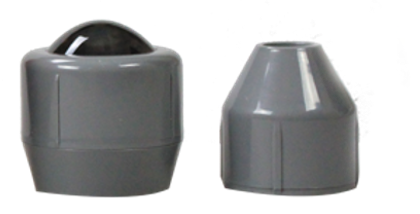
Small treatment heads are useful for
-
Small patients such as cats or small dogs
-
Distal limbs
-
Trigger points
-
Acupuncture points
-
Small focal lesions
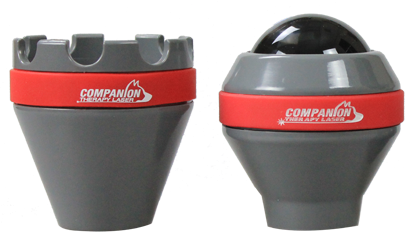
Larger treatment heads are preferable for
-
Large muscle groups & soft tissue injuries
-
Osteoarthritis
-
Extensive wounds
-
Postoperative incisions
-
Broad treatment fields of any kind (including thoracic or abdominal conditions)
When to Use Contact Application
In general, contact application should be considered the preferred method for deep tissue conditions—any pathology that is not directly visible to the eye or lies beneath skin, fascia, mucosa, or muscle.
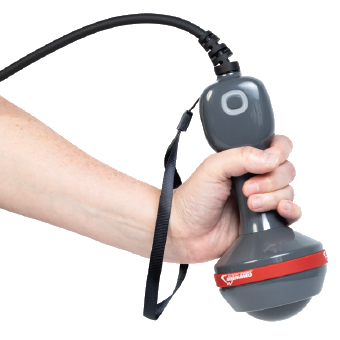
Examples include
-
Osteoarthritis
-
Tendinopathies & myositis
-
Soft tissue injuries
-
Intervertebral disc disease
-
Thoracic conditions
-
Abdominal conditions
-
Middle or inner ear disease
-
Urinary conditions
In these cases, maximizing penetration is essential. Contact treatment also provides tactile feedback for the operator and can produce mild massage-like effects that may help reduce myofascial tension.
When Non-Contact Application Is Preferred
Non-contact treatment is designed for different clinical situations. For superficial pathology, penetration depth is less important because the target tissue is already near the surface. Non-contact treatment also improves practicality and hygiene in contaminated or delicate areas.
Non-contact applicators are generally preferred for
-
Open wounds
-
Incisions
-
Dermatologic conditions
-
External ear disease
-
Oral mucosal lesions
-
Areas with exudate or infection
-
Hypersensitive or painful skin
-
Sterile surgical fields (intra-op treatments)
These applications are typically treated from approximately 4-7 cm away from the tissue surface.
Combination Approaches
Many veterinary conditions benefit from combining both techniques during the same treatment session.
Otitis externa is an excellent example. The pinna and external ear are treated in a non-contact manner because of sensitivity, surface inflammation & any exudate present. However, switching to a contact applicator around the base of the ear during the second phase of treatment addresses deeper canal tissues and improves treatment of deeper inflammatory components.
Similarly, oral surgery patients, fractures with orthopedic repair, and complex wounds frequently contain both superficial and deep tissue pathology. Combining non-contact treatment for open surfaces with contact treatment around surrounding tissues often provides the most comprehensive therapeutic approach for optimal pain management and healing.
Important Software Guidance Consideration for Companion CTX-IQ, CTS-DUO, and CTS DUO +Therapy Lasers
For the Companion model lasers listed above, the software interface may display a green ring around certain treatment heads during protocol selection. This indicator means that the selected treatment head is safe to use at the chosen protocol and power setting, but it does not necessarily mean that it is the ideal applicator for that specific condition and optimal for treatment efficacy.
For example, the large non-contact treatment head (“large cone”) may appear highlighted in green for arthritis, pain/trauma protocols because it is safe from an irradiance standpoint. However, as discussed previously, these deeper musculoskeletal conditions should always be treated using an on-contact delivery method whenever possible to maximize photon penetration into deeper tissues. In most cases, this means selecting the large or XL contact treatment heads (XL available on DUO/DUO+ models only) rather than the large non-contact cone.
Exceptions may include patients that are extremely hypersensitive or painful to physical touch, although this is relatively uncommon in most orthopedic and rehabilitation patients. It is much more common for patients to experience discomfort from thermal buildup in the haircoat and/or skin during deep tissue dosing, especially if a large enough area is not treated (not allowing one area to thermally relax prior to returning to treat the same spot), or if the handpiece is not moved at an appropriate speed.
As a general guide, the size areas that should be treated for the deep tissue protocols (Arthritis, Pain/Trauma, Edema/Swelling) include quite a large area including the joint itself, as well as approximately half the distance to the next most proximal & distal joints on the limb. This includes treating circumferentially as well, where possible. For the spinal column, this includes an area directly over the spine itself, plus several inches to either side in the paraspinal muscles, aiming towards the spinal column. All staff members involved with laser treatment of patients should review these treatment areas so that they are familiar with the appropriate landmarks to treat within for each protocol.
Monitoring the Patient During Treatment
Whether treating ON or OFF contact, the haircoat and skin should be monitored during treatment using either a “trailing finger technique” or by checking the temperature of the treatment area hair and skin with the opposite hand (the one not holding the handpiece) during treatment.
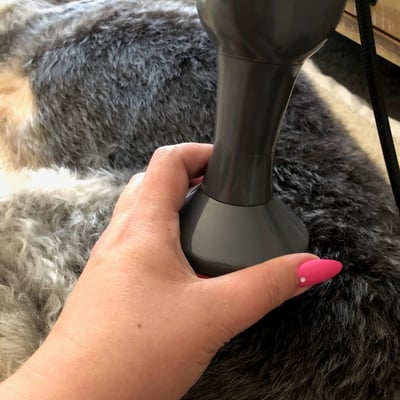
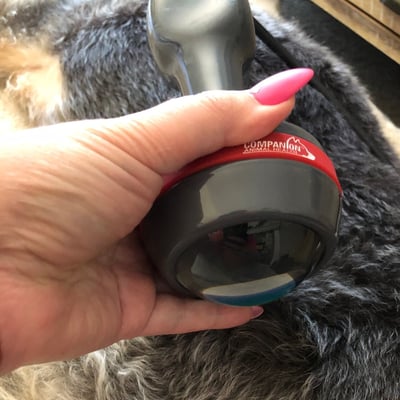
If the area feels too warm to the touch to the laser operator, or if the patient is experiencing discomfort (vocalizing, attempting to move limb or body away from the handpiece or laser operator, trying to bite or investigate the treatment area) this is an indication that the area being treated should either be expanded (treat a larger area to allow more time for a certain spot to thermally relax/cool off before coming back to the same area), the power (W) should be turned down (2-3W increments are usually a good place to start), or the laser operator should move the handpiece faster over the treatment area.
If questions arise regarding treatment head selection, delivery method, or protocol optimization, users are encouraged to contact the Companion clinical team for guidance.
Practical Takeaways
Successful PBMT is not simply about entering a protocol into the laser. Appropriate treatment head selection and delivery method are fundamental components of dose delivery.
A useful clinical rule is
-
Deep pathology = contact application
-
Superficial pathology = non-contact application
Understanding when and why to use each approach helps maximize photon delivery, improve treatment consistency, and optimize patient outcomes. As veterinary PBMT continues to evolve, these practical treatment fundamentals remain among the most important determinants of clinical success.